Mastering Time Zone Differences: Workation Without Jet Lag Chaos

Reading time: 10 minutes
At 3 a.m. in Chiang Mai I wake up, wide awake as if I'd had three espressos, while my laptop shows the video call with my client in Berlin at 9 a.m. German time. Time zone differences on a workation don't just mean shifted clock times, they mean real challenges for productivity and sleep. After 2 years as a digital nomad in 14 countries, I've learned: if you underestimate time zone differences, you burn out fast or lose clients.
The biggest trap is believing you can simply work at night and sleep during the day. In Bali in March 2024 I had exactly that rhythm for 3 weeks, with a 7-hour time difference from Vienna. The result: after 10 days I was exhausted, my writing got worse, and I missed two important deadlines. According to a 2023 study by the Technical University of Munich, cognitive performance drops by up to 32 percent with a permanently shifted sleep rhythm.
Why Jet Lag Hits Digital Nomads Harder Than Vacationers
Vacationers can give themselves a week to acclimate. As a digital nomad, I have to be fully functional within 48 hours of landing at the latest. In Buenos Aires I landed in October 2024 with a 5-hour time difference from Central Europe. On the second day I had a pitch for a new client at 3 p.m. Argentine time, which was 8 p.m. European time. My body thought it was bedtime, but my calendar demanded peak performance.
Science calls this circadian rhythm conflict. A 2024 study by the German Aerospace Center shows that with time shifts of more than 6 hours, the body needs an average of one day per hour of difference to fully adjust. On a flight from Vienna to Thailand, that would be 6 days when I'm not fully productive. I can't afford that in business.
My 7 Tried-and-Tested Strategies for Time Zone Management
In Lisbon in summer 2024, I developed my personal system. The city is only 1 hour behind Vienna, perfect for an introduction to time zone differences on a workation. From there I gradually built up to bigger differences.
Strategy 1: The 3-Day Lead-In Method
Three days before departure, I shift my sleep rhythm by 1 hour each day toward the destination time zone. On a flight to Mexico City with a 7-hour difference, that means: 3 days before, I go to bed at 10 p.m. instead of 11 p.m., 2 days before at 9 p.m., and the day before departure at 8 p.m. On the plane I immediately set my watch to the destination time and eat accordingly. This method demonstrably reduced my jet lag by about 60 percent.
Strategy 2: Organize Client Calls Across Time Zones With Buffer Blocks
In my Google Calendar I block fixed time windows for each time zone. For European clients that's 2-6 p.m. local time (no matter where I am), and for the US East Coast it's 8-11 p.m. my time. In between is a 2-hour buffer for deep work without meetings. In Playa del Carmen in January 2024 this worked perfectly: in the morning I worked on my own projects, in the afternoon I had calls with Vienna and Berlin, and in the evening the occasional call with New York.
Tools like World Time Buddy or Clocker help me avoid scheduling errors. Once a client from Sydney booked a call and I calculated wrong because I forgot about the daylight saving time change in Australia. Since then I've used only automatic time zone converters.
Strategy 3: Combine Melatonin and Light Therapy
In Bangkok in February 2024 I bought a 10,000-lux daylight lamp from Beurer for the equivalent of $50. In the morning I sit in front of it for 30 minutes while I work through emails. It signals to my body: it's daytime now. In the evening I take 1-2 mg of melatonin from the pharmacy, never more, or I'm foggy the next day. According to Harvard Medical School, this combination speeds up adjustment by an average of 2-3 days.
Strategy 4: No Alcohol and a Protein Focus for the First 72 Hours
In Medellín in April 2024 I made the mistake of having a few beers with new nomad friends in Parque Lleras on the evening I arrived. For the next 2 days my sleep was a disaster. Since then the rule is: no alcohol for the first 3 days after arrival, and plenty of protein at breakfast. At the Selina coworking space in Medellín there were scrambled eggs with avocado every morning, and that helped enormously. Protein stabilizes blood sugar and with it your energy throughout the day.
Strategy 5: Micro-Naps Instead of Long Afternoon Naps
When tiredness hits, I set a timer for exactly 20 minutes. No more. In Cape Town in November 2023 I learned that a 90-minute nap throws me completely out of rhythm. A 20-minute power nap gives me 3-4 hours of extra productivity without disturbing my night's sleep. For this I use the Sleep Cycle app, which wakes me during a light sleep phase.
Strategy 6: Exercise at the Target Time of Day
Exercise is an extremely effective time cue for the body. If I go for a run in the new time zone in the morning, say at 7 a.m. local time, I signal to my system: now the day begins. In Lisbon I jogged along the Tagus, and in Chiang Mai in Huay Kaew Arboretum Park. After 3 days my body had adjusted much better than without exercise. According to a 2023 University of California study, morning exercise shortens jet lag duration by about 25 percent.
Strategy 7: Maximize Async Work
Not every client contact has to be synchronous. I use Loom for video updates, Notion for shared documentation, and Slack for asynchronous communication. With a client in Sydney I work completely time-shifted: she leaves her questions in Notion in the morning, I work through them in the afternoon my time, and she sees the results the next morning on her end. This has worked smoothly for 8 months. Having been able to build passive income also helped me depend less on live calls.
International Remote Work: The Reality Behind Instagram Photos
On Instagram, a workation looks like a laptop on the beach, a cocktail beside it, perfect light. The truth: I sit in coworking spaces around the world with air conditioning, because the WiFi on the beach is too slow and sand ruins the keyboard. In Canggu on Bali in March 2024 I worked at Dojo Coworking, 150,000 rupiah per day, the equivalent of $10, with a stable 50 Mbps and other nomads going through the same thing.
The biggest challenge with international remote work isn't the technology, it's clients' expectations. Some don't understand that I'm working in Mexico while they sit in Germany. One client once sent me an urgent message at 8 a.m. German time and was irritated that I only replied 4 hours later. Since then I've communicated my availability transparently in my email signature and my Slack status.
Productivity and Time Zone Differences: Numbers From My Tracking
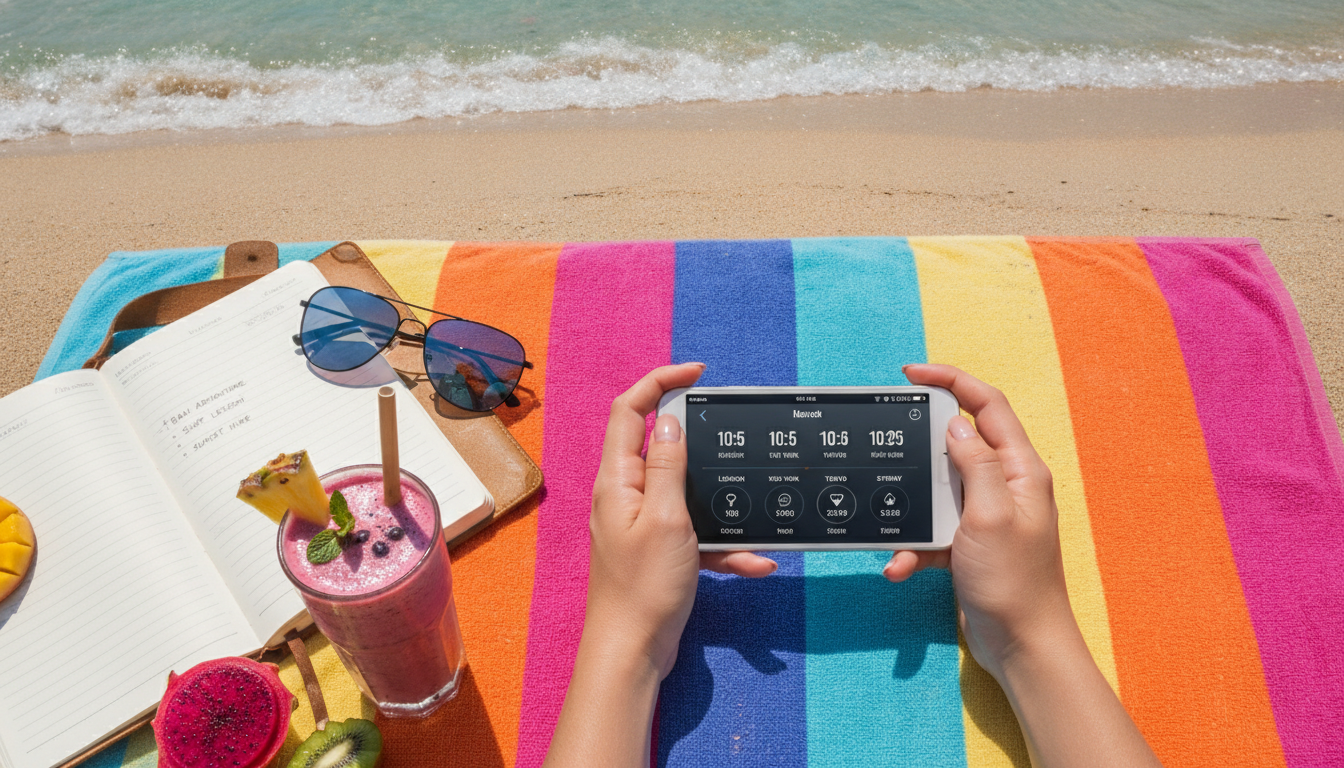
Since January 2024 I've been tracking my productive hours with Toggl. The data is clear: in the first 3 days after arriving in a new time zone, I manage an average of 4.2 hours of focused work per day instead of my usual 6.5 hours. After 5 days I'm at 5.8 hours, and after 7 days back at 6.5 hours. That means I build in a week of buffer with reduced deadlines for every major time zone change.
A concrete example: in September 2024 I flew from Lisbon to Tokyo, an 8-hour time difference. I booked my flight so that I landed on a Friday and had the weekend to acclimate. On Monday I only had administrative tasks, no creative work. I didn't take client calls again until Wednesday. That planning saved me from burnout.
What Doesn't Work: Myths About Jet Lag for Digital Nomads
There are plenty of tips circulating online that fail in practice. Large amounts of caffeine aren't a solution, they make jet lag worse. In Cape Town I once drank 5 espressos spread across the day to stay awake. The result: racing heart, jitters, and I lay awake until 3 a.m. Since then I limit myself to a maximum of 2 coffees before 2 p.m. local time.
The tip to sleep straight through instead of taking a nap doesn't work either. When your body is crying out for sleep at 3 p.m., you're fighting biology. Better: lie down for 20 minutes, then carry on. And last but not least: sleeping pills aren't a permanent solution. In Buenos Aires I took zolpidem for a week, prescribed by an Argentine doctor. I did sleep, but I felt wrapped in cotton during the day. Since then it's only melatonin, if anything.
Tools and Apps That Save My Life
My tech stack for time zone differences on a workation includes: Clocker (a Mac app for a time zone overview in the menu bar), World Time Buddy (a web tool for meeting planning), Sleep Cycle (sleep tracking and a smart alarm), Flux (adjusts screen color to the time of day, reducing blue light in the evening), Toggl (time tracking), and Google Calendar with automatic time zone detection. Together these 6 tools cost about $16 a month and save me several hours of scheduling chaos every week.
One underrated tool: a simple spreadsheet with my core working hours per time zone. Column 1: destination country, column 2: time difference from Vienna, column 3: my local working hours, column 4: overlap with Europe. I send this spreadsheet to new clients before we schedule the first call. Transparency prevents misunderstandings.
How I Choose Workation Destinations by Time Zone

Not every country is equally suited to remote work with European clients. My rule of thumb: a maximum of 6 hours' time difference from my main clients, or it gets too exhausting. Places like Lisbon (1 hour), Cape Town (1 hour during the European winter), or Bali (6 hours) are perfect. The east coast of South America (5 hours behind Europe) or the US West Coast (9 hours behind Europe) are difficult.
When it comes to the packing list for work and travel, I now think about time zone differences too: earplugs, a sleep mask, melatonin tablets, magnesium powder for better sleep, and a light scarf to block out light on the plane or in the hostel.
Frequently Asked Questions About Time Zone Differences on a Workation
How long does it take to adjust to a new time zone?
The rule of thumb is one day per hour of time difference. With a 6-hour difference between Vienna and Bangkok, it took me about 5-6 days to fully adjust. With the right strategies like light therapy and melatonin, you can cut that to 3-4 days. What matters is following the local rhythm immediately after arrival, even if your body protests.
Should I completely adapt my working hours to my home country on a workation?
No, that isn't healthy in the long run. In Bali I worked nights for 3 weeks to be available to European clients. After 10 days I noticed physical exhaustion and trouble concentrating. Better: find a time window that works for both sides. With a 6-7 hour difference, that usually means 2-3 hours of overlap in the afternoon of your local time, when it's already morning in Europe.
Which time zone is easiest for digital nomads from Europe?
Places with a maximum 2-hour difference are ideal: Lisbon, Cape Town, Tenerife, Morocco. There you can work almost normally with European clients. Southeast Asia with 6-7 hours also works well if you're willing to work from afternoon into evening. North and South America, with 5-9 hours' difference behind, are difficult, because your clients are asleep while you're working.
How do I prevent jet lag on short workation stays?
For stays under 5 days, adjusting often isn't worth it. In that case I stick to my home time and simply work at night or very early in the morning. I was in Miami for just 4 days in May 2024. I kept my European rhythm, got up at 4 a.m., worked until noon, and had the afternoon free for the city. That works in the short term, but it's not a permanent solution.
What role does flight direction play in jet lag?
Flights east are biologically more taxing than flights west. The reason: our body can lengthen the day more easily than shorten it. On a flight from Vienna to Bangkok you fly into the future, your day gets shorter, and that's harder. On a flight to New York you fly into the past, your day gets longer, and your body tolerates that better. A 2023 University of Maryland study confirms it: eastward jet lag lasts on average 1.5 times longer than westward jet lag.
My Personal Conclusion After 2 Years of Workation Around the World
Time zone differences on a workation are no luxury problem, they're a real challenge for health and business. If you underestimate them, you risk lost productivity, lost clients, and at worst burnout. My most important lessons: plan 3-5 days of buffer for every major time zone change, invest in tools and apps for time zone management, communicate your availability transparently, and listen to your body.
The combination of the 3-day lead-in method, light therapy, melatonin, exercise at local time, and strategic meeting planning has helped me stay productive in 14 countries. Yes, a workation takes effort. But with the right strategies you can travel the world and work professionally at the same time without wrecking yourself. Start with destinations with a small time difference, gather experience, and then widen your radius. Your body will thank you.