Double Taxation Treaties: Don't Pay Tax Twice

Reading time: 11 minutes
I was sitting in my small apartment in Melbourne, staring at my pay slip from the coffee bar and then at my Austrian tax return. 823 AUD had been withheld from my two weeks of waitressing, and now the tax office in Vienna wanted money from me, too. My first thought: "This can't be legal!" Spoiler: it isn't, if you use the double taxation treaty correctly. In this article, I'll show you exactly how to avoid paying taxes in two countries at once, and how I later got €1,247 (about $1,360) back.
A double taxation treaty sounds like dry bureaucratese at first, but it's your best friend when working abroad. I'll explain step by step what you need to know, without legalese, promise. When I started my Work and Travel year in Australia in 2019, I would have wanted exactly this kind of guide.
What is a double taxation treaty and why does it affect you?
A double taxation treaty is an agreement between two countries that regulates where you pay taxes if you live in one country and work in the other. Austria has concluded such treaties with 90 countries, including all the important Work and Travel destinations like Australia, New Zealand, Canada and Japan. According to the Austrian Federal Ministry of Finance, these treaties are meant to prevent your income from being taxed twice.
In practice, that means: if you work in Australia and pay tax there, you don't have to pay the full tax again in Austria. There are two methods used in the treaties: the exemption method and the credit method. With the exemption method, your foreign income is completely tax-free in Austria. With the credit method, the taxes paid abroad are credited against your Austrian tax liability.
For me in Australia, the credit method applied. That means I did have to file a tax return in Austria, but I could have the 823 AUD I'd paid in Melbourne credited. In the end, I paid exactly zero euros in additional tax in Austria, because the Australian tax was higher than the Austrian calculation for that income.
Tax liability in Austria despite a stay abroad
This is where it gets important: even if you work for a year in New Zealand or Canada, you can remain liable for tax in Austria. What matters is your place of residence and your habitual abode. Under the Austrian Income Tax Act, you have unlimited tax liability if you have a residence in Austria or stay here for more than six months of the year.
I had sublet my apartment in Vienna but was still officially registered. That made me subject to unlimited tax liability in Austria. Many of my friends from the coworking space in Chiang Mai had deregistered their apartments completely and were only subject to limited tax liability, which means they only had to pay tax on Austrian income, not on their foreign income.
The rule is simple: if you keep your primary residence in Austria, you have to pay tax in Austria on your worldwide income. The double taxation treaty then makes sure you don't pay twice. If you deregister completely and live abroad for more than six months, you're only subject to limited tax liability. A tax advisor from the firm Taxpertise in Vienna's 1st district, Schottenring 14, explained to me: "With classic Work and Travel on a Working Holiday visa, most people remain subject to unlimited tax liability because they aren't emigrating permanently."
How does tax crediting work with a double taxation treaty for Work and Travel?
The credit method works like this: you pay taxes abroad, file your tax return in Austria at the end of the year and report your foreign income there. The tax office then calculates how much tax you would have to pay in Austria. From that amount, they deduct the tax you already paid abroad. If the foreign tax is higher, you pay nothing more. If it's lower, you pay the difference.
An example from my real case: I earned 12,400 AUD in Australia in four months. 2,480 AUD in wage tax was deducted from that (20 percent). Converted, that was about €7,920 ($8,630) of income and €1,584 ($1,725) in tax. For that €7,920, the Austrian tax office calculated a tax of roughly €800 ($870). But since I had already paid €1,584 in Australia, my tax liability in Austria was zero. Even better: I couldn't claim the difference back, because Austria doesn't pay out more than it would have calculated itself, but I didn't have to pay anything extra.
It's important to keep all your records: pay slips, the Tax File Number notice from Australia, confirmation of taxes paid (in Australia called a "Payment Summary" or, since 2019, an "Income Statement"). You need these documents for the employee tax assessment in Austria. According to the Australian Taxation Office, Working Holiday Makers are their own tax category with a tax-free threshold of 45,000 AUD per year, with 15 percent tax paid on income above that.
Tax refund from abroad: How to get your money back
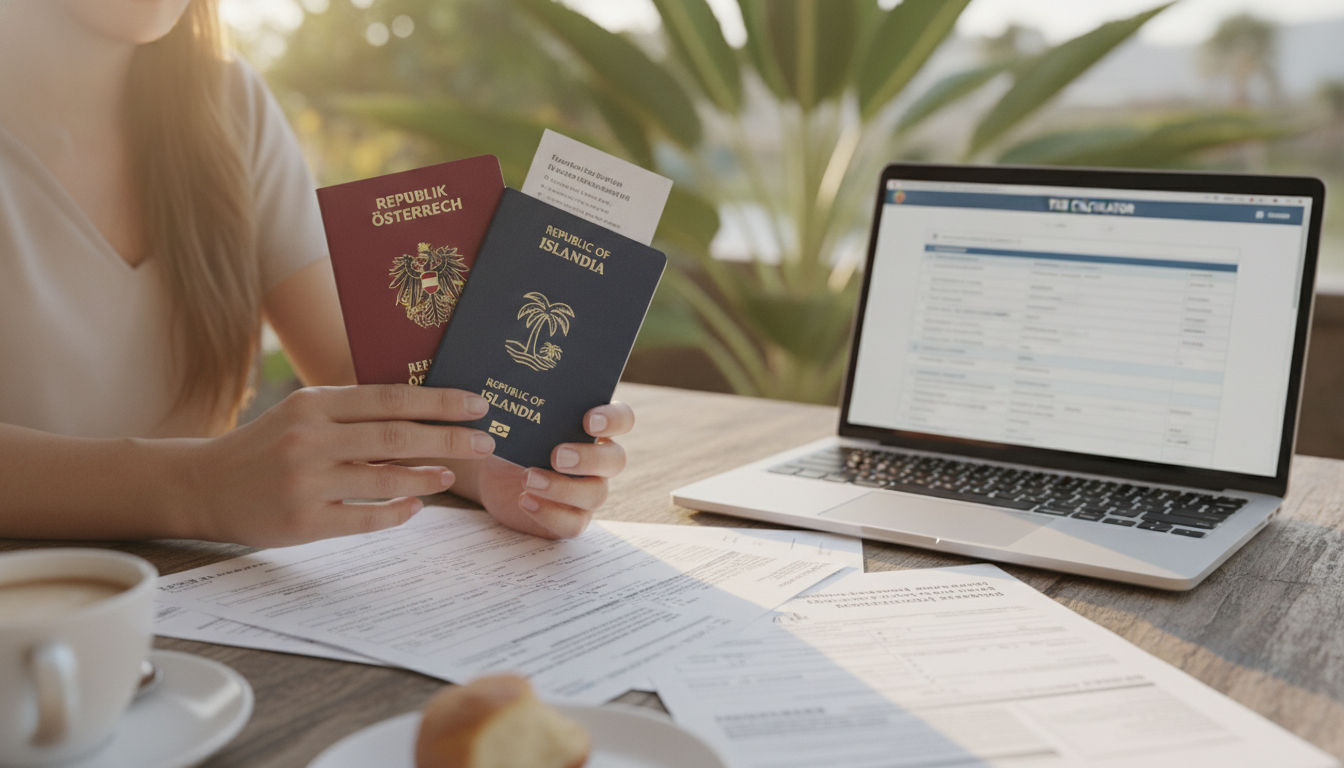
This is where it gets really interesting, because many people pay too much tax abroad. In Australia, for example, employers often withhold a flat 32.5 percent, even though as a Working Holiday Maker you should only pay 15 percent on the first 45,000 AUD. Through my tax refund in Australia, I got 1,247 AUD back, which comes to roughly €795 ($865).
Here's how the tax refund works: after the end of the Australian tax year (which ends on June 30), you can file your tax return online through the myGov portal. You need your Tax File Number, all the Payment Summaries from your employers and your bank details. I did the refund myself, and it took 14 days for the money to arrive in my Australian account.
Alternatively, there are agencies like Taxback.com or Working Holiday Tax Solutions that take care of this for you. They charge between 80 and 150 AUD in fees, though. My recommendation: if you only had one or two employers, do it yourself. In more complicated cases, such as multiple jobs, freelance income or different states, an agency can be worth it.
- Collect all pay slips and confirmations of taxes paid from every country
- Make sure you have the official tax number of the respective country (TFN in Australia, IRD in New Zealand, SIN in Canada)
- File your foreign tax return on time, usually within 12 months after the end of the tax year
- Enter your foreign income in the Austrian employee tax assessment (Form L1) under code 724
- Attach a copy of the foreign tax certificate and a translation if the tax office asks for it
Common mistakes with double taxation treaties and how to avoid them
Mistake number one: many people think they don't have to file a tax return in Austria if they worked abroad. Wrong! As long as you're registered in Austria, you're required to report your worldwide income. I know two people from my year abroad after high school who had to pay back taxes plus interest because of this, in one case €2,300 ($2,500).
Mistake number two: not keeping records. The tax office wants proof that you paid taxes abroad. Without a Payment Summary or a comparable document, you can't have the foreign tax credited. Scan all documents and save them in the cloud, not just on your phone.
Mistake number three: not applying for the foreign tax refund. In Australia, for example, your entitlements don't expire, and you can file your tax return even two or three years later. But the longer you wait, the harder it gets to get hold of old documents. My tip: take care of it right after June 30, when the tax year ends.
Mistake number four: forgetting social insurance. The double taxation treaty only covers income tax, not social insurance. In many countries, you also have to pay into pension funds. In Australia it's called "superannuation" and amounts to 11 percent of your wages. If you leave the country permanently, you can claim this money back. I got another 1,120 AUD that way. But watch out: a 65 percent withholding tax applies to it, so only about 392 AUD is left.
Special cases: Self-employment, freelancing and digital nomads
As a freelancer or digital nomad, it gets more complicated. Wage tax isn't automatically withheld here, so you have to make sure yourself that you meet your tax obligations. During my Work and Travel, I worked on the side as a social media manager for a Viennese startup, remotely, 15 hours a week, €800 ($870) a month.
I had to pay tax on this income in Austria as self-employed income, even though I was in Australia. Why? Because my client was based in Austria and I was still officially resident in Vienna. For self-employment, the residence principle often applies: you pay taxes where you're resident, not where your client is.
If you work as a digital nomad and stay in one country for more than six months, you can become tax liable there, regardless of your official residence. In Thailand, for example, you're considered a tax resident after 180 days. Most digital nomads move on every few months to avoid this. In an article on passive income, I've already described how important it is to document your income streams cleanly for tax purposes.
How do I avoid double taxation as a self-employed person abroad?
As a self-employed person, you have to take action yourself. Register your business in Austria if you work from Austria, even remotely. Pay your income tax and social insurance there. If you have income in another country, check the relevant double taxation treaty. The general rule: permanent establishments abroad are taxed there, while income without a fixed place of business is taxed at your place of residence.
At the time, I hired a tax advisor in Vienna who knows international tax law. It cost me €320 ($350) for the first year, but it probably saved me several thousand euros' worth of stress. You can deduct the advice as a business expense, by the way.
Checklist: These are the documents you need for your tax return

For the Austrian employee tax assessment after your year abroad, you need the following documents: all foreign pay slips, confirmation of taxes paid abroad (e.g. a Payment Summary from Australia), your foreign tax number, bank statements as proof that the money was received, possibly a translation of the documents into German, Form L1 for the employee tax assessment, and a copy of the double taxation treaty in case the tax office asks (you'll find it on the BMF website).
I also had a letter from my Australian employer confirming when I was employed there and how much I had earned. That was helpful when the Vienna tax office asked why I had no Austrian income for four months.
When do I have to file my tax return in Austria?
The deadline for the employee tax assessment is June 30 of the following year. If you worked abroad in 2024, you have to file your return by June 30, 2025. You can extend the deadline if you hire a tax advisor, in which case the deadline is usually April of the year after next.
My tip: do it as early as possible. The earlier you file, the sooner you get any refund. I filed my return in September, and by November I already had the assessment notice and the refund in my account.
FAQ: Most common questions about double taxation treaties for Work and Travel
Do I have to pay taxes abroad and in Austria if I do Work and Travel?
You pay taxes where you work, which means abroad. In Austria, you have to report your foreign income in your tax return if you're still registered here. Thanks to the double taxation treaty, though, the taxes paid abroad are credited, so you generally don't pay twice. With the credit method, you pay at most the difference if the Austrian tax would be higher than the foreign one.
How exactly does a double taxation treaty work when working abroad?
The double taxation treaty regulates which country may levy taxes and how double taxation is avoided. For employment income, the general rule is: the country where you work may tax it (source country). Your country of residence (Austria) credits these taxes or exempts the income. You have to file a tax return in Austria, report your foreign income and submit proof of foreign taxes paid. The tax office then calculates your final tax burden, taking the foreign payment into account.
Can I get taxes back after a Working Holiday?
Yes, in both countries. In the host country, you can often apply for a tax refund if too much was withheld, in Australia, for example, through the tax return. In Austria, you get money back if your annual tax liability is lower than the advance payments or wage tax already paid. The foreign taxes are credited, but there is no double refund. So you can't claim the same amount back twice.
What happens if I don't file a tax return in Austria after Work and Travel?
If you have unlimited tax liability in Austria (residence here), you're required to report your worldwide income. If you don't, you risk back payments, interest and, in the worst case, a penalty for tax evasion. The tax office often learns about your foreign income through automatic data exchange between countries. I strongly advise: file the return even if you think you won't owe anything. You'll often even get money back.
Does the double taxation treaty also apply to social insurance?
No, double taxation treaties only regulate taxes, not social insurance. For social insurance, there are separate agreements between EU countries (EU regulations) and bilateral social security agreements with non-EU countries. In Australia, Working Holiday Makers normally don't pay Australian social insurance, only superannuation (the pension fund). You can claim it back when you leave, but a 65 percent withholding tax applies. In Austria, you usually remain voluntarily insured or are covered abroad through the e-card.
Conclusion: Avoiding double taxation is easier than you think
My most important tip after three Work and Travel stays in Australia, New Zealand and Canada: don't be afraid of the tax topic. Yes, it's annoying. Yes, the forms are confusing. But with the right documents and some basic knowledge, you save hundreds or even thousands of euros. For me, it was over €2,000 ($2,180) in total that I got back through correct tax returns and refund claims.
The most important points once more: keep all pay slips and tax documents, file your tax return in both countries on time, use the double taxation treaty to your advantage, and don't hesitate to consult a tax advisor when it gets complicated. The few hundred euros in consulting fees are a good investment if they spare you four-figure back payments.
By the way: even if you've been back for a while, you can still file tax returns retroactively. In Austria, you can file an employee tax assessment up to five years retroactively. So even if your Work and Travel was in 2020, you have until the end of 2025. Don't give money away to the state, get back what you're entitled to!